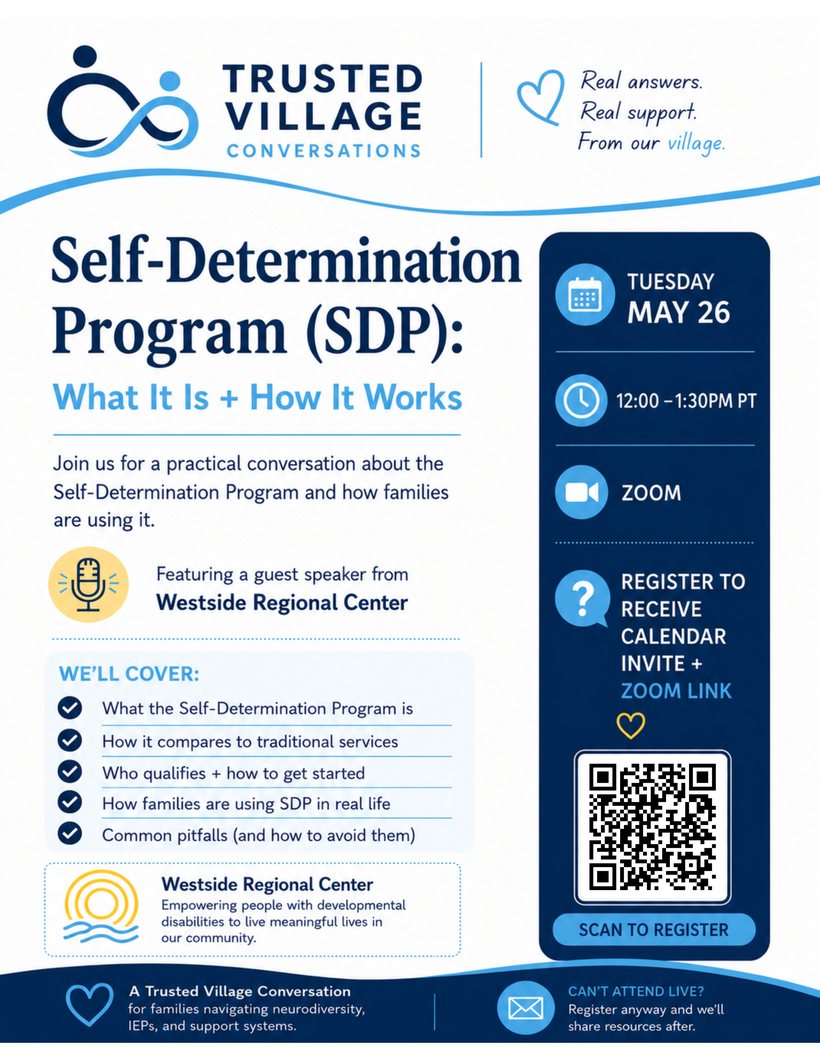
A practical conversation about the Self-Determination Program and how families are using it, featuring a guest speaker from Westside Regional Center.
Captions are available via the CC button in the player.
Lily Ablon: Excellent. So for those of you who don't know me, I'm Lily. I run Trusted Village. Trusted Village is a community for families navigating neurodiversity, education supports, IEPs, therapies, resources, all the things that come with trying to figure out what our kids need at school, at home, and in the world. The goal is to create a space where families can connect with each other. Ask questions, share what's actually working, and find trusted resources. The self-determination program has been coming up a lot in our WhatsApp community, and I've also been seeing parents ask about it in other local parent spaces. People are curious, but it can feel confusing. What is SDP? Who qualifies? How is it different from traditional regional center services? How do you actually get started? And what does it look like in real life? So, I wanted to learn more, too, and Grace Lanzetta was very gracious to help make this happen by connecting us with some folks from the Westside Regional Center who could walk us through the program and answer questions directly. So we are very lucky to have Abigail Walker with us today. Abigail is the Self-Determination Program Manager for Westside Regional Center. She has worked in the Regional Center system since 2017 in several roles, including the adult… including as an adult service coordinator, Adult Program Manager, Early Childhood Program Manager, and now Self-Determination Program Manager. Before that, she worked with… directly with individuals and families families as a respite provider, in-home supportive services, or IHSS, direct care provider, and inclusion assistant supporting children with developmental disabilities. To effectively integrate with their peers at the Boys and Girls Club. Abigail, in her own words, is passionate about self-determination and helping individuals and families feel more comfortable and confident as they begin their SDP journeys. Abigail has brought along Vanessa Mendoza-Kiria, a service coordinator at the Westside Regional Center. And we are also joined by Grace Lanzetta, who is in her family's fifth year of self-determination. Grace is passionate about helping other families understand the opportunities SDP can create, especially as children move towards adulthood with more respect, autonomy, and support around their individual needs and interests. In her own words, Grace feels particularly encouraged about the program's benefits for her 17-year-old daughter's adult years. Knowing that her daughter will be supported to create an adulthood based on individual needs and interests alleviates a lot of worries for the future. She is such a believer in the program that she became an independent facilitator last year. So a couple of logistics before we start. Feel free to drop questions in the chat as we go. I will keep an eye on it and help moderate it when we get to the Q&A portion. And we will have time for Q&A at the end. Abigail and Vanessa and Grace have generously agreed to stay and answer questions. We have until 1.30, so thank you so much for all of that time. So, with that, I will turn it over to Abigail.
Abigail Walker: All right, thank you so much, Lily, for that introduction, and thank you, everybody, for being here. Thank you, Grace, for helping coordinate this. We're really trying to do a lot of outreach. making sure that everybody knows about self-determination and just the regional center system in general. So we're really, really glad to have you all here. And I apologize, the lighting in here is not great. I'm not sure what's… what's going on, but… And also, my, like I said, my computer decided to restart, and now I can't open the presentation. So, Vanessa, I emailed it to you. I don't know if you're able to share your screen.
Lily Ablon: If not, I know you send it to me. So, Vanessa, let me know, and…
Abigail Walker: Okay.
Lily Ablon: I can also make you a host, too.
Parent: We can get… We can make it…
Lily Ablon: Work.
Abigail Walker: Perfect. Always a technical difficulty.
Vanessa Mendoza-Kihira: No, I think I can share it. Okay, great.
Abigail Walker: Awesome. Thank you, Vanessa.
Vanessa Mendoza-Kihira: Nope, I'm sorry, I can't actually see what you guys can see.
Abigail Walker: It's kind of a zoomed-in version.
Vanessa Mendoza-Kihira: You want me…
Abigail Walker: Should be able to.
Vanessa Mendoza-Kihira: Right now.
Abigail Walker: Perfect.
Vanessa Mendoza-Kihira: Alright!
Abigail Walker: Awesome. All right, so hi, I'm Abigail Walker. I'm the Self-Determination Program Manager, as Lily said, at Westside Regional Center, and Vanessa Mendoza-Kahira's here as well. She is one of the service coordinators in my team, helping support the Self-Determination Program at Westside Regional Center. So, I don't know how familiar this audience is with the regional center system in general, but traditional services is essentially what the whole system has been based on for, you know, many years since the regional centers were were implemented. And essentially, there's pre-approved vendors that have to go through the regional center onboarding process. through our community services team to be regional center providers. So, essentially allowing, people to pay, for services, but only those services that have been pre-approved by the regional center. So no outside vendors are available. They have to go through the regional center. Next slide, please. And… traditional services might not be ideal for every individual served. You'll see the little infographic, you know, a square peg in a round hole. We don't want to put people in boxes unnecessarily. A lot of individuals and families struggle to identify and secure appropriate and available staff. Be that direct support, various providers in the community, and that's for many reasons, right? It could be cultural, language, geographic location, staff availability, etc. There's a lot of things that make each of us very unique, and the things that we need very unique. And there might not be an appropriate or viable option under the traditional vendored services that could meet the individual's needs. Hence, SDP. Next slide. So, about a year ago, Westside Regional Center invested in designating a specific unit, and we are very, very grateful, to really focus on serving the self-determination program and the individuals served under that program. Making it more equitable, increasing timelines, doing outreach opportunities like this. So we're, we're super proud of our team, Vanessa being one of the staff on that team. So we have 10 designated SDPSCs, as the acronym will be. There's a lot of acronyms in this world. And they're all designated and doing SDP all day, every day. They have, slightly smaller caseloads. So that they can really focus on helping families navigate the process, if there's intense or, higher level needs than, you know, typically… that we would typically see. They're assigned to an SDP SC, but they're also Set as mentors to the other units. So we'll talk about that a little bit more, but essentially, I just want to highlight that at Westside, we're, we're, focused on really trying to expedite timelines, make the process smoother, be a helping hand and a guiding light for families and individuals who want to pursue SDP, but might not know where to start, or, you know, what the various components are. So, because we want to build capacity across the regional center, the SDB team is assigned as mentors to the other units, so… any service coordinator at Westside Regional Center has somebody that they can go to if they have questions, if they need support throughout the process, from very… varying degrees of, support needs. But essentially, Westside has invested in, helping families navigate SDP. Thank you, Ness. Next slide, please. So, what is the Self-Determination Program, or SDP? It allows participants opportunity to have more control in developing their service plans and selecting the service providers to better meet their needs. You can always go back into the traditional service system if it's not if SDP isn't working well for you. The only caveat there is if you exit SDP, you have to wait a year to re-enter, and that's just mostly due to technicality and logistics of moving the funds around from the two models. But I will say, I… I don't think I've seen anybody exit as DPA once they've entered, at least from the year that I have been in this role. So, just to share that it is… it is a voluntary program, you can always go back to traditional. All right, so SDP, it's about the person, the way… leading the way that they want their services provided, what type of services and supports they need, and then most essentially selecting who will support them from the existing regional center vendor, or from… individuals and agencies not currently connected to the regional center. So, what does that mean? Essentially, you can have a combination of vendered and non-vendored regional center providers. Or you could have all non-vendored providers, right? So it allows a lot of flexibility. Maybe there's a swim class that really works well with the individual that you support or love. And you don't want to give that up by moving over to SDP, that's okay. You can still use some vendor providers if you would choose to do so. Next slide, please. So, self-determination is built on 5 pillars. Freedom, the right, to the freedom to control your life, authority, the power to control an individual budget and decide which services and support options, to purchase with that budget. Support the right to find and secure resources and staff that help you live how you want to. Responsibility, the responsibility to use public money wisely. And finally, confirmation, the right to oversee the services you want, understanding and verifying that you play a crucial role in making decisions in your life. And here's just a little infographic of those, five pillars that I just shared. We'll make sure to get the slides out to you all after this. But essentially, SDP is about being the captain of your own ship. So, we really want to, emphasize the idea that it's about the individual. It's about freedom, it's about choice and individualized, care and support, and thinking not just about, you know, who's gonna care for my loved one tomorrow, but what do they want for their hopes and dreams and future, and… you know, really thinking outside the box is what SDP is all about. So, who is eligible for regional, or for, sorry, for SDP, supports? Any individual who is Status 2? or Lanterman eligible, which is the other way to say it, can enter the SDP program. The only caveat is that they cannot live in a licensed long-term healthcare facility, but essentially, if you are with the regional center and have a diagnosis that will keep you in the regional center system for life, you can enter SDP. The other… conditions to agree to is that you have to attend an orientation through the Department of Developmental Services, State Council on Developmental Disabilities. It's a two-part, two-hour each orientation, but it's really a lot of really great information. They go very in-depth. And I think it's, you know, it's… it's definitely helpful. And then you must use a financial management service. That's essentially how the payments get routed for the services that are provided. You have to agree to manage the cost of self-determination services, make sure expenses are staying within the individual budget plan. And only purchasing services that are eligible for federal funding, and not available from generic community services or natural support. So, just like in traditional We need to exhaust all generic resources, including the school district or insurance, and your SDP team and your financial management service will help you make sure you're staying within those parameters. So, 3 key components, in SDP. You have your circle of support, the people who know you and… or your loved one very well, and are there to support them, coming together and creating a person-centered plan. So, what does my life look like now? What do I want it to look like in the future? What matters to me? What's most important to me? And how do we document that in the Individualized Program Plan, IPP, which is a document through the regional center system that's essentially a contract between you, your family, and the regional center. What are the needs? What are we agreeing that are… the needs are that need to be funded? And what does that look like on paper, right? So those three steps, it's essentially just mapping out a plan for you. Next slide, please. And there are 4 key elements in SDP. Like we mentioned, the person-centered plan and the individual program plan, what are the needs? And how are we gonna address them? The individual budget, the spending plan, and the financial management service. So, the individual budget is based on what would the regional center have spent on you in a 12-month period. So, in traditional, what is the amount of money, kind of as a collective pot, that we would have paid, for your services under the traditional model? And that's how your individualized budget is calculated. Here's another infographic that's just going to break down the process and how enrollment works. So again, we'll share these slides after with you. We hope that this makes it a little more streamlined, and you can reference back to it if you ever, you know, get confused in the process. But again, SDP Team is here to help. Next slide, Ness. So, the individualized budget can be adjusted. As we all know, life changes, and things change, and circumstances change. We all go through transitions, and the needs, and circumstances might need to be updated in the budget. once you have your set budget, that's great, but you can always come back to the table and say, this changed in my life, you know, I have this other need, and the budget can be reopened, moved around. And the IPP, your contract between the family and the regional center would be updated as well, to kind of have that golden thread linking what services are being provided, how we're paying for them, and what the goals are. And the spending plan is, how are we going to spend the money? how are the money… is the money that we built into the budget going to be used to effectively meet the needs of the individual, in an effective way? So, it's based on the individual's personal goals that are documented in that contract, the IPP. And again, to emphasize that we're ensuring that the services listed in that spending plan don't replace natural supports, generic resources, etc. So we still need to use insurance. School district, all that good stuff. So the Financial Management Service Agency, or the FMS, handles the funding allocated for your services via your SDP spending plan. They process payroll for employees if people choose to hire their own staff. They help with taxes, labor law compliance. things like that. Monthly summaries they provide to help you and the Regional Center stay on track with spending. You know, things are going to change from month to month, but it's helpful to know where you are in the process, making sure that you're not Overspending and, you know. Panicking and running out of money, so the monthly spending reports help to kind of keep… keep everybody on the team in track, in check. Checking qualifications… oh, sorry, Ness. For your chosen service provider, so they'll do background checks and, you know, help with… help with the qualifications. If you're working with a, you know, clinician, for example, making sure they have the correct and necessary qualifications, and then helping make sure that the funds allocated are spent based on funding regulations for those services. So it's a lot of the legality of the money side of things. Next slide. And we have been growing, growing, growing at Westside. Again, we were very, very thankful to, Westside Management for investing in this team. We think it has… actually, we know it has made a really big impact on the smoothness, and I think… one back, yeah, it's documented through the increases in enrollment that we've had, we think that this speaks to not only how well the SDP team has kind of got up and running, but how much it's helping the families, streamline the enrollment process, help with any adjustments throughout the year, answer questions for service coordinators. So this 780, I actually just checked the numbers earlier, and we are at 816, so we are just… climbing, climbing, climbing, and we're not seeing the numbers go down. So, I think people are really satisfied, with SDP, especially at Westside, and we're really, really proud of that. So, anyone who wants to learn more, there is the, like I mentioned, the orientation, on the State Council of Developmental Disabilities website. It's very interactive, it's, there's a Q&A at the end, so it's a live session, and they have a lot of different availabilities, different languages offered, and it, it really digs deeper into a lot of the topics that I kind of just touched on today. And then if you have any other questions, you can also reach out to your Westside Regional Center Service Coordinator. Or if you don't know who that is, or don't know where to start, you can always reach out to Anthony Davis, who is our, administrative assistant, and he can help guide you to the correct person, or you can always reach out to me as well. I'll make sure my contact information gets sent out to you all. And that is our general overview of SDP. Thank you so much. I wanted to make sure to leave a lot of time for, questions, and also not go too crazy deep when, you know… So yeah, thank you so much.
Lily Ablon: Incredible. Abigail, thank you so much for flying through that. That was, a lot of information and a great little nugget to get us excited to ask more questions. We're gonna open up for questions now, so feel free to drop anything into the chat. You are welcome to unmute as well. I will help moderate and make sure we get through as many as we can. I will also stop the recording right now.
Abigail Walker: And I'm gonna…